

The Scoop
WIR/FRRC – DON’T EXPECT ANY MAJOR SLM RULE CHANGES FOR “THURSDAY NIGHT THUNDER” IN ’27

Posted on: Wednesday October 28, 2026
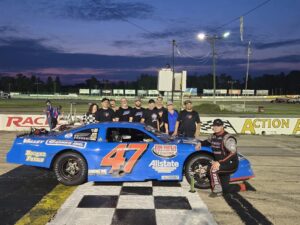
Riley Stenjem wheeled the Chase Motorsports 47 to victory lane at WIR in Kaukauna June 5. (Stenjem Motorsports photo)
Several northeastern Wisconsin pavement super late model teams and owners have opined on the recent announcement regarding the future of the ASA Midwest Tour. And, at least for now, it doesn’t appear that much, if anything will change for the super late models on Thursday nights at Wisconsin International Raceway in Kaukauna.
It was recently announced that the southern-based CARS super late model tour will essentially ‘take over’ what was the ASA Midwest Tour in 2027.
The new ownership group of former NASCAR star Kevin Harvick, Tim Huddleston and Marty Melo will adopt what is being called the ULRA super late model rules in ’27. Part of their “mission” if you will is to attempt to create a common set of rules for pavement super late model racing across the country.
Easier said than done, right?
While the announcement was made that all CARS Midwest Tour super late model events will pay a minimum of $10,000-to-win and $2,000-to-start, the rules packages this new group is pushing could wind up costing teams that wish to enter any of these touring events more money down the road.
Among the rule changes are the switch from a 2 bbl to a 4 bbl carbuerator. What effect, if any, will that have on the events at WIR IN Kaukauna – in particular the popular “Traditional Tuesday Night Biggie” the Dixieland race (now known as the Gandrud Auto Group 250)?
I reached out to a handful of super late model drivers, some car owners and Fox River Racing Club president, Tom Hockers.
WIR’s “Thursday Night Thunder” remains the ONLY paved oval in Wisconsin that still runs super late models on a WEEKLY basis. Not a five-race series. A full, weekly schedule.
And while the car counts aren’t nearly what they were 20 or 25 years ago, there are almost always enough cars for a full feature field – between 14-20 cars MOST nights. Here are the comments:
Tom Hockers – FRRC president and former late model racer.
“I honestly think the racing by us at WIR on Thursday nights was pretty good last year. Anytime you try to instill rule changes, it typically can create havoc and increase costs for the racers.”
Jason Shultz – FRRC/WIR Competition Director
“For our weekly, 2027 show for the Fox River Racing Club, we will remain on the 2 bbl carbs. After speaking with the promoters from Dells Raceway Park, Slinger Super Speedway and Golden Sands Speedway in Plover, it’s my impression that they too, will stay with the 2 bbl carbs for SLM events in 2027. To sum it up, at least with regards to the weekly show at WIR, there won’t be much change. I do think for 2027 regional racing will be pivotal and will be interesting to see what the Midwest Tour’s schedule looks like upon release. But, that also leaves weekly racing poised to gain cars if teams that have focused their budgets on the MWT in past years, decide not to support their events (or fewer of them) in 2027.”
Dennis Chase – Car owner, Riley Stenjem & Casey Johnson – “This sport has always cost a lot of money, and it’s only going to get worse, I’m afraid. If for some reason we all had to convert to running a 4 barrel carb, I feel that could potentially wipe out 20 to 40 percent of the super late model teams at WIR. I mean, even with the success we’ve had at WIR (Chase’s team won the 2026 FRRC SLM title with Riley Stenjem and Casey Johnson co-driving) it’s so incredibly hard to pay for this stuff.
On pavement, we don’t have a sanctioning body to follow, like the dirt tracks do. With the dirt cars locally, you can build a car that can compete from Maine to California. That’s not happening anytime soon on the pavement, unfortunately.
When you talk about the WIR regulars, the only ones who really travel much at all would be our team and maybe Andy Monday and (Grant) Griesbach. Our team has only missed one Thursday night race since 2008. It’s almost too expensive to get into a super late model. Some of the teams that compete on Thursday nights more than likely won’t be around much after two or three years. Another part of what they talk about is the haulers to transport the cars. It doesn’t get talked about enough. My trailer is well over 25 years old, and I tow it with a 2003 truck. Any rules change will cost teams a lot of money.
What we’re doing collectively doesn’t make much sense, really. No matter what they do with the rules, it will cost you money. I’ve got an ACE motor for sale. It’s been on the market for more than six weeks. I haven’t had any interest in it. I think the ACE motor program is dead. I think it remains to be seen if shows like the Dixieland, the Joe Shear Memorial and others may still stay on a two barrel carb. We don’t know those things yet. Things remain very much in flux with this stuff. I don’t think it’s really promoter’s egos more than it’s about economics. I think the CARS tour going to a minimum $10,000-to-win and $2,000-to-start will help a little bit. At least there is some meat on the bone, now. At that STARS tour race at Slinger last spring our car finished third and we got paid $600. We dumped close to $3200 in tires for that race at Slinger. And I don’t care what Hoosier says – the tires they give us are always changing.”
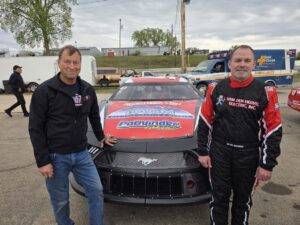
Scott Vandenheuvel (left) poses with Jeff Van Oudenhoven.
Scott Vandenheuvel – car owner, Jeff Van Oudenhoven – “(The Tour) going to a 4 barrel carb is not going to affect FRRC /WIR since there won’t be a chance that the club would adopt the rules of the tour. We pretty much follow the UMA unified Rules package that the Dells- Slinger etc follow.
I do believe the thought process for the 4 bbl carb is to have a nation wide Super Late Model Rule package. The 2 bbl is more of a Midwest SLM rule package. One thing that will happen is the speeds of the cars will increase probably 3-5 tenths of a second. It doesn’t sound like much, but it is. Fans can’t see that be we sure can.
Regarding the added costs we would incur – our team already has a Hamner SSPE engine and that engine can support a 4bbl and is probably the most used engine type with the 4 bbl along with the sealed engines. We also have an ACE engine, but since a 4 bbl adds approximately 90-100 horsepower, that is really not a good combo since the ACE engines are built to run the 2bbl up here and most have lighter connecting rods which are rated at about 550 HP. A 4 bbl would put a lot of stress on those parts.
So really, all we would have to do is purchase a 750 VDL carb for about $1400.00 – a new 4bbl spacer – about $125.00 and a new 5 Star air box for around $580 so about $2,100 cost. We will also have to spend some dollars on dyno tuning the engine since we don’t have a lot of 4 bbl history to properly jet the carb, etc. We also have to change our engine setback to 2 inches since we have a rear mounted distributor. Yes, we will have more wear on brakes and rotors. Talking to Jeff (Van Oudenhoven) we believe the added horsepower will make driver ability to utilize the added horsepower an advantage not to use up the tires. Hoosier has a very grippy tire which really doesn’t fall off much in shorter features with the 2 bbl. A 4 bbl changes that.
I think Kevin Harvick being involved with this CARS series will help. The real issue is super late model racing is getting quite expensive. But, if you do race this series, the higher guaranteed start money offsets a lot of the extra cost. But, you need to do more the a few starts to make that happen. These are my initial thoughts on this. We probably will get a 4 bbl setup to run some tour events.”
Andy Monday SLM driver – “I’m not sure the changes will have any impact on local racing at WIR. We have a good group of guys that all understand the most economical way to race weekly is with what we all already own. Significant changes costs racers their own hard earned money and 95% of the local teams don’t travel regardless.
Honestly, I know there is a lot of push back on the 2bbl vs 4bbl debate, I see both sides of it. We raced the Dixieland 250 in 2023 with a 4bbl and it made for some great racing with tire falloff. The added expense with buying a good carb and airbox is part of the pushback, but real racers understand they might need to change exhaust systems also to be at peak performance on a 4 bbl package.
Right now, it’s hard to say as the rules haven’t been released for 2027. Derek Rehm has been around the sport a long time. He is receptive to listening to feedback from the teams. I guess once the rules are released then we can understand financial impacts. $2,000 to start each race might absorb those changes quickly for the tour.
(Kevin) Harvick and (Dale) Earnhardt Jr both being involved is a good thing. More publicity, more TV exposure – more excitement. Every race they join the stands are packed. If we do what we’ve always done, we will get what we’ve always got. Change isn’t always bad.”
Jay Vander Loop – car owner, J.J. Vander Loop – “We are aware of the rule change(s), however, at this time, I do not believe WIR, Slinger, Plover, Dells are in agreement with the changes and early conversations lead me to believe most or all rules for the FRRC and other tracks will not change or adapt to the ASA/CARS rule.
If a change becomes necessary I believe it will incur a minimum of a $2,500 spend for a carburetor and such to adapt. I believe your local guy that would sometimes run the ASA/CARS tour now may back away because of the need for a carburetor and such. That would then reduce the car count for these tour races. Rule changes only cost the teams/drivers money and generally never make a significant difference one way or another.”
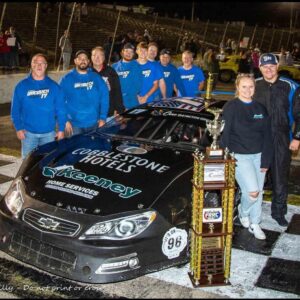
Grant Griesbach poses with his team following his 2025 FRRC super late model championship. (seeking photo credit)
Grant Griesbach SLM driver – “I don’t believe these rule changes will affect WIR in any way as it seems that this change is just for the tour only. I fear with more and more change that the participation in the Dixieland might suffer from it but that will be it. I don’t believe the carb change will be a big difference other than more wear and tear on parts such as motors, axles, brakes, etc which aren’t cheap to replace or rebuild. The main concern I have with the tour is if they implement mandatory tire and fuel purchases that eats into the 2k to start in a hurry. This year a set of tires was $840 with the tour and two sets would be $1,680 assuming no price increases, which almost already eliminates the start money.”
Michael Anthony – SLM driver – “The Midwest tour trying to adapt to rules not run around here is going to cause issues. For years, we have had discussions on how to reduce the cost of racing in hopes of bringing new people in, bringing back people that got out of it due to the rising cost and keeping existing people involved. Things are getting way more expensive then what is made off of it, so it’s easier for people to say it’s not worth it and they quit and move on.
I have seen rules like what the ULRA are pushing tried and failed on multiple occasions and that did drive people out of the sport. This will most definitely cost teams money. Most teams have multiple carbs. In case something happens or for tuning purposes so now they would buy 2 which costs $1200 -$1500 each then a $600 air intake.
Then, depending on the engine builder, they will have to have the rods and pistons changed because they use a lighter weight rod and piston in certain builds. That probably cost $ 10,000 roughly. With 4 barrel, racing engines need rebuilding more often due to the extra wear and tear. My current motor I’ve run two years. I change valve springs before the start of the second season.
I don’t believe any tracks in the area are switching to ULRA rules. I like Kevin Harvick, and seeing him invest back into the sport I think is huge. Unfortunately, I don’t agree with how they are doing it. Over the years, anytime people from down south tried getting involved in racing around here it has always come with the attitude that they know best. I have tried several times to have conversations with some of them in hopes to try and find a common ground and I was treated poorly and talked down to like I was stupid.
I remember when the Stars National Tour tried running the 4 barrel package at WIR for the Dixieland in 2024 and it was the lowest car count I have ever made a parking map for and I have been doing the parking for them with my Dad for over 10 years.
I tried talking to Freddie Query because he had asked why no locals showed up and I told him it’s because of their rules. A normal budget, weekly team can’t afford to run and thats very unfortunate cause if done right that race should bring 30 or more cars, which in turn would bring alot more fans. But, we can’t keep up with the guys that show up with 4 brand new tires on the car then buy 2 sets to practice on then buy whatever quantity of race tires allowed to make $1200 to start. When a set of tires cost roughly $800. So they spend $3200 on 4 sets while a normal guy might spend $1600.”
I’ve been covering the racing scene in Wisconsin for five decades now, on dirt and pavement. On the dirt, the common rules package with IMCA (International Motor Contest Association) has helped maintain healthy car counts in the modified, stock car and sportmod divisions. Granted, the sanctioning body is far from perfect.
However, even if a track isn’t sanctioned, drivers most of the time on the dirt can run their car(s) without having to really change anything except maybe gears. Is getting a common set of rules for pavement, super late model racing a realistic goal? Often track and series promoters, and clubs, all have different ideas about what rules package to run. Egos often get in the way. That, along with economics.
I equate this to the 9:1 compression motor rule that kicked off in 1980. That basically saved pavement late model racing not only in Wisconsin, but in the Midwest as well. I saw firsthand many drivers who used to compete on both dirt and pavement make the decision around the early 1980’s to commit full time to the pavement.
Back then, it was much more affordable to switch the the tar with the 9:1 compression rule. Guys like Scott Hansen, Terry Baldry, J.J. Smith, Cliff Ebben and Lowell Bennett are just some of the drivers who ditched the dirt and went full steam ahead racing on the pavement back in the day.
Earlier this week, a release announcing the formation of the “Wisconsin Challenge Series” for Super Late Models dropped. According to the presser, the rules package will utilize the “Unifed Super Late Model Rules which remain consistent throughout the state.”
The shows will pay a minimum of $750-to-start and $5,000-to-win. These shows will be contested on the Hoosier Racing Tires ST1 and ST2 combination. The specials that fall under this series’ ‘umbrella’ include the annual Icebreaker 100 at Dells Raceway Park April 10, the May 29 “Salute The Troops 100” race at Jefferson Speedway, and a pair of shows at Madison International Speedway, another show at Jefferson, and shows at Slinger, another show at DRP and The Trickle 99 at Oktoberfest at LaCrosse Fairgrounds Speedway.
The only constant in short track racing IS change. It’s been going on for decades, and it appears things will continue to be shaken up again as we look ahead to the 2027 racing season on the pavement.