

The Scoop
WHY WEEKLY RACING REMAINS VITAL IN 2026

Posted on: Monday April 13, 2026
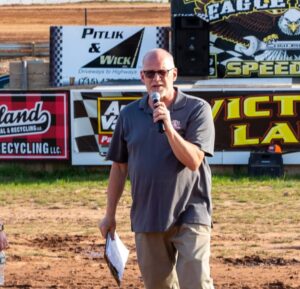
Joe Verdegan, shown here announcing at Eagle River Speedway in 2023, has been calling races throughout the Midwest for 44 seasons. (flintography.com)
WHY WEEKLY RACING REMAINS VITAL FOR THE SHORT TRACK INDUSTRY
In recent years, the state of short track racing has seen a shift of sorts when it comes to weekly racing.
Not that long ago, if you owned a race car you RACED IT whenever and wherever you could. A generation or two ago, drivers would frequently opt out of attending a family wedding, graduation party or any other family-related event. Instead, being at the race track on a Friday or Saturday night took priority over any type of family function.
As we sit here in 2026, priorities have changed. As I’ve written about on this website many times, the new generation of racers won’t think twice about skipping a race or two (or more) to do anything other than being at the track.
A decade or two ago, drivers were often rewarded for their commitment to any respective track’s weekly racing program. There was a VALUE to racing weekly.
Often, there were sizeable point fund checks. Racing-related contingency prizes were plentiful, and drivers got a sense of being rewarded or even compensated in part for their commitment to a track (or series) weekly program.
I’d say within the past 10-15 years, a shift in chasing the high-dollar specials (moreso on the dirt) has seemed to trump any weekly commitment. However, I do think weekly racing still has it’s place in our sport, despite the changing landscape of our sport.
Think about it. Shawano Speedway has been a Saturday tradition now since the 1960’s. In fact, in the late 1970’s and even into the 1980’s, Shawano Speedway had their radio ads mention “S.O.S. – Shawano on Saturdays.” I remember seeing that slogan in both Midwest Racing News and Checkered Flag Racing News ads as well.
Both of those racing trade papers bit the dust in the mid-00’s with the explosion of the internet. But even the Fox River Racing Club (FRRC) touts it’s weekly show at Wisconsin International Raceway as “Thursday Night Thunder.” At WIR, that strong Thursday night tradition has been well-known throughout the Fox Valley. It’s also safe to say that close to 80 percent of the drivers who battle regularly at WIR – for the most part – only race at WIR (with some exceptions obviously).
Why is weekly racing STILL an important part of our sport? I’ve got a few suggestions.
If you are operating a track, if it’s possible with the weather, run as many nights as possible to boost your value to potential marketing partners. If a track schedules say an 18-night, weekly schedule of racing, that offers a bigger value to the local businesses who opt to support the track by purchasing a billboard, sponsoring a night or even sponsoring a division. More bang for the buck you might say.
And let’s face it. At least in Wisconsin (where Mother Nature has been bi-polar for quite some time now) odds are a track will often lose anywhere from two-to-four nights of racing per season as it is due to a rainout.
New drivers. Ponder this for a minute. If someone wants to cut their teeth in short track racing, it’s a lot easier for someone new to compete weekly if they can, to have a chance for more seat time. Over the years, I had the privilege of watching a number of new drivers elect to start in the back of the pack. Those drivers earned respect. Eventually started passing cars, and then start in their regular starting spot. That’s much easier for a driver to get more seat time when there are potentially more nights to run. That’s where a weekly schedule can certainly help out. Because if a track runs mainly “specials only” or hosts just touring series events, it’s tougher for a new racer to get some seat time.
Driver’s marketing partners. It doesn’t take a rocket scientist to realize if a driver races at a track that hosts an 18-date schedule versus a seven-0r-eight race schedule, that’s more of a VALUE to that driver’s respective sponsors/marketing partners. An obvious bigger bang for their buck, no different than value for the track itself.
Consistency for fans. I specifically recall scenarios at Luxemburg Speedway in years past where (for whatever reason) the track didn’t host a race on the track’s regularly-scheduled night. Guess what happened? Fans showed up at the track, wondering why there wasn’t racing that night? That’s a good way to lose a race fan. I’ve heard tales of this occurring at other ovals, too.
Granted, with MOST everyone on social media these days, the odds are rare that an old school fan simply showing up on a night that a track normally hosts racing are less these days. But it still occurs. That is a challenge facing tracks that host race events on many different nights of the week. For some tracks, based upon what their nearby competition does, it’s almost a necessity.
Weather-related challenges. Most tracks will encounter some rainouts during the course of the scheduled season. Some seasons are better than others. By running a full schedule, a track promoter can perhaps make up some potential revenue on those nights when you do rainout. And with every track being a seasonable business, that window to make any type of profit remains slim. Heck, Eagle River Speedway’s season for the most part runs from Memorial Day weekend through Labor Day weekend. Track promoter Pat Zdroik knows that tourist-related crowd sort of disappears once September rolls around. Every track faces it’s own unique challenges. Most tracks begin to see the “Dog Days” around mid-to-late July and into August when car count and fan attendance continues to drop. And, it can still be awfully tough to compete against high school football when that kicks off around mid-to-late August.
With that said, you hope those “better nights” earlier in the season can make up for those nights when the crowds and car counts are sparse, and making a profit can be close to impossible during those unavoidable “Dog Days.”
Drawing the non-race fan. One of the biggest reasons for track’s to host weekly racing is that it offers that many more opportunities to draw that “non-race fan” to the track. I’ve preached this for years – our hardcore fan base has continued to die off within the last 10-15 years. That built-in demographic of diehard race fan is pretty tough to find these days.
With more nights on your schedule, with today’s busy families it provides more opportunities to draw that family of four who wouldn’t know a Crown Vic from an IMCA stock car. I see it at Eagle River Speedway many Tuesdays, for example. I can spot a vacationer from a hardcore fan a mile away. They have no idea what they are watching. But they are there, having a great time, and spending money at the track. THAT’S what successful track promoters NEED to do for these tracks to remain financially solvent.
Successful promoters in 2026 and beyond will give those free passes away like candy BUT they’ve got to get into the hands of folks who’ve never been to a race before. You can always recognize your regular fans with a fan appreciation night or something of that nature. Getting those new faces to the track is huge. Is it hard work? You bet it is. Track promoters have most likely ditched rounding up a point fund or a ton of contingencies because it’s a lot of WORK. That goes back to staffing those weekly racing tracks. I did that stuff myself over the years.
And that, my friends, will be another column for another day! We’ll see you at the track soon!
I’d love to hear your views on this column. Email me day or night at jverdegan2@gmail.com and opine!