

The Vault
MAY 1, 1966 – PRESS-GAZETTE PREVIEW OF DE PERE OPENER WITH NESS, PETERS

Posted on: Monday October 19, 2026
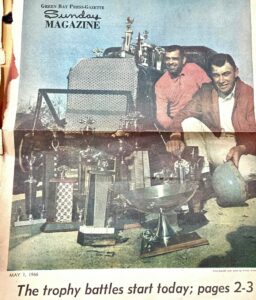
TOP DRIVERS READY FOR NEW STOCK CAR SEASON
(Peters, Ness will continue battle for honors as action starts on NEW dirt, blacktop tracks)
REPRINTED FROM THE MAY 1, 1966 SUNDAY EDITION OF THE GREEN BAY PRESS GAZETTE AS PENNED BY JIM ZIMA
Some sportsmen pefer hunting, fishing and bowling, but if you’re a Ted Peters or an Earl Ness you like driving – stock car driving that is.
Peters and Ness are the premier drivers among 160 racers who compete at three area tracks throughout the summer. All have been preparing for today’s opening date at the Brown County Fairgrounds, De Pere.
The drivers belong to the Northern Stock Car club which sanctions races at De Pere, Luxemburg and Seymour. Racing at the Kewaunee County Fairgrounds in Luxemburg is scheduled to begin May 15 while the Outagamie County Fairgrounds track in Seymour will open about June 1 with racing every Wednesday night.
There are many other tracks preparing to open, including the 141 Speedway in Manitowoc County, The K & K track near Kaukauna, several in the Appleton-Oshkosh area and the Shawano County Fairgrounds.
Peters and Ness are oldtimers in racing. Between them, they have logged 31 years of competition, consistently finishing on the list of top drivers. The two have taken home more than 50 trophies.
Peters, 34, has 15 years of maneuvering the jalopies under his belt while Ness, 10 years older at 44, is a 16-year veteran. Peters dethroned Ness as the club champion in 1965 compiling 470 points, awarded on a how-you-finish basis in each race. Ness settled for the runnerup spot with 430 points.
Individually, Peters won championships on the dirt tracks at Luxemburg and Seymour while Ness edged him out for the title on the blacktop track at De Pere. Both agree that the other is his toughest competition.
If you think they are in the game for the money you are wrong. “I like the stiff competition, if there was no challenge to it there wouldn’t be any fun. If the competition wasn’t there, I would probably quit,” says Ness.
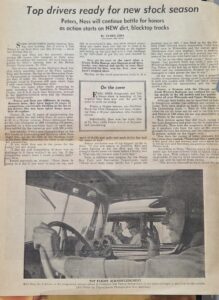
Peters expounds on the money. “Sure, there is money in it but if you want to stay on top, and this is everybody elses aim, you stick almost everything you make back into the car to keep it in shape. I personally enjoy working on the engines and setting up the cars and it is a real challenge to get his car and himself to win.”
Ness got his start in the sport after a friend, Rollie Hansen, now flagman at all three tracks, was injured and unable to race. Earl substituted for him, won his first race and hasn’t stopped since.
Racing, as the track announcers term it, is a sport of thrills and spills and each driver has had his share of both.
Peters attributes one of his biggest thrills to Ness. “It was last season at Seymour, Earl and I were fighting it out for first and the lead changed hands six times before I finally won it. That was the hardest race I ever had.”
Ness, a full time tree surgeon for the Green Bay Park and Recreation Department, said, “There have been many thrills but I guess the greatest was in 1957. I was lined up for the 200-mile USAC (United States Automobile Club) late model race in Milwaukee and the starter said, ‘Gentlemen start your engines’. There is nothing like that sound and as you look around you see some of the drivers have tears in their eyes.”
“As far as the older model racing,” Ness continued, “my greatest thrill was when I won the Wisconsin-Michigan championship in 1951. I passed Don Renier on the last lap at Spies Field in Menominee and my transmission dropped out but I managed to coast across the line to win.”
Of the two drivers, Ness has had a greater variety of experience, having raced in seven states in both late models with USAC and IMCA (International Motor Contest Association) and the older late model cars.
Peters, a fireman with the Chicago and Northwestern Railroad, has confined his racing mainly to the old models and has participated all over Wisconsin and Upper Michigan.
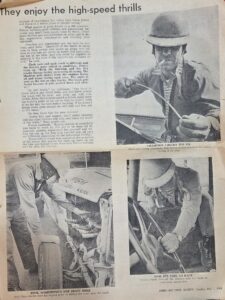
Although their hobby can be described as highly dangerous, neither has suffered any serious injuries. both were shaken up badly in accidents at the Luxemburg track – Ness in 1964 when he rolled his car six times end for end in the first turn and Peters in 1965 when his car was demolished in a collision on the same turn.
Both drivers agree that dirt track racing is the most dangerous and point out the 1/2 mile track specifically. They note the roughness of the track as it develops from ruts from the cars as the events proceed through the evening and the comparitively greater speeds on the bigger oval.
How does the racing of today compare with that when they got started. “Years ago there were just a few good cars and drivers, now more know how to set up cars and therefore competition is fiercer,” Peters said.
According to Ness, “Racing was a lot rougher years ago because drivers tried to knock you out of the race. With today’s rules that is virtually impossible. If you try to hit someone to gain position, you will be barred from racing.
“The drivers themselves have about the same amount of experience but today they learn faster and there is a better class of people racing.”
What makes a good driver is a $64 question. Peters believes good reflexes and paramount, because you don’t have much time to think. Other main factors are concentrating on what you’re doing, experience, coordination and knowing your opponent.
Practice and experience are the keys to success, says Ness. “One-third of the battle if being able to keep power and speed up going into the turn so you can get speed up faster and pass coming out of the turn. And you must be capable of passing in the turn if the opportunity presents itself,” he said.
Each race and each track is different and the drivers must adjust to conditions. Peters sums up: Both the blacktop and the dirt tracks change during an evening of racing. The blacktop gets slicker from the engines losing oil and water during each race. The same is true on the dirt or clay tracks. The track gets faster because it gets packed down and slicker.”
“In dirt track,” he continues, “you have to know where the chuck goles are and know where the track will be level and your car will ride better.
After this is determined a driver must know the braking point of his car so that he doesn’t push it too far into the turn before braking. If he doesn’t break down soon enough he will skid and lose out in the turns.”
Do they have tips for new drivers?
“Drive fair and square, don’t make enemies and the older drivers will help you learn the tricks of the trade,” Ness points out.
“Peters contends, “Racing mainly is something you have to work at. It’s got to be done all by yourself, gaining experience for yourself and setting the car up the way it is best for you, and cars are different depending on the individual driving.”
There will be many new names on the program at the races this season but right up there on top the fans are bound to see Ness and Peters battling side by side, for the top.