

The Scoop
COLEMAN RACING PRODUCTS – SERVING RACERS GOING ON 60 YEARS

Posted on: Monday September 29, 2025
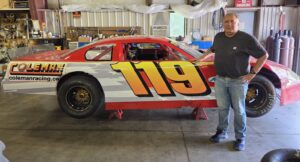
Dickie Coleman poses next to the iconic 119 super late model at their Menominee, Michigan race shop.
A long-standing racing parts business in Menominee, Michigan remains strong going on 60 years.
Coleman Racing Products started out in a small wooden, shack in 1965. A very young Gene Coleman essentially ‘bet the farm’ and went ‘all in’ on a commercial machine shop.
Decades later, Gene’s been retired for sometime, and Dickie Coleman, Gene’s son, remains the sole owner of Coleman Racing Products. The business has survived many changes in the world of short track racing. Coleman remains a strong presence in motorsports, continuing to develop high performance products for racers across the United States and Canada.
“When Dad started this business, he wasn’t even racing at all, initially,” Dickie Coleman said. “Dad was a one-man band at the beginning. Over the years, Dad slowly began building up the business, eventually hiring 8 to ten employees. And things took off from there.”
Dickie began handling menial chores at just nine years old around the shop. “I learned how to run a saw, a drill press and swept floors through my teenage years,” Dickie recalled. “Up until the early 1980’s, we were mostly a manual machining company.”
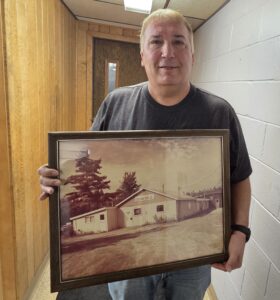
Dickie Coleman poses with a photo of the shop that currently houses Coleman Racing Products.
It was in 1980 when the new building which currently houses Coleman Racing Products was constructed. It was around that era in the early ’80’s when the short track industry sort of ‘broke loose’ as Coleman pointed out. “The regular machining-type work began to slow a little bit, and with Dad being a racer, it was a natural transition into designing and selling racing products.”
The ’80’s were a time when the short track industry transitioned from building cars sometimes with junkyard parts to using almost exclusively fabricated racing products that were useful and drivers bought them. That’s where Coleman Racing Products stepped in.
“We were the first ones to bring directional vein brake rotors to the industry for cooling,” Coleman pointed out. “Those are utilized by pretty much every race car in the country these days.”
In addition to the brake rotors, Coleman was the first to introduce aluminum driveshafts and the quick release steering hub. The steering hub design was prompted by a scary crash by Norway Speedway Hall of Famer Bruce White at Dells Raceway Park. White flipped over, and an oil fire erupted. “These were true game-changers for race teams back then,” Coleman said. “Back then in the ’80’s, it was like the Wild West. Guys could run an unlimited tires, and there was a large variety of engine combinations you could run. When it came to new parts, if you could build it and dream it up, you could run it for the most part.”
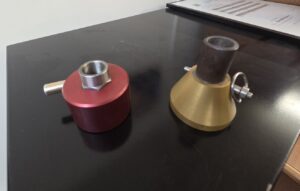
The quick release steering hub designed by Coleman Racing Products.
This year, Coleman Racing Products employs 22 people. “At our peak in the mid-1990’s, we had just under 50 employees during the period I like to call the Kevin Cywinski era.”
Cywinski raced the Coleman No. 119 car, and had a ton of success chasing some of the top short track events and series in the Midwest. Many other drivers have wheeled the 119 car over the decades – most recently Neenah’s Braison Bennett in 2025. The “Flying Z” Dalton Zehr had a great run in Coleman’s 119 car. Others who’ve wheeled the car include Troy Nelson, Johnny, Travis and Tim Sauter, Steve Holzhausen and even Jason Schuler.
According to Dickie, 2026 will mostly likely be Gene Coleman’s final hurrah as a car owner. “We plan to have Dalton come back up and run the 119 car for five super late model shows at Norway. Gene and Dalton had a ton of success, and Gene wants to have his final run as a car owner with Dalton. Braison did a wonderful job wheeling our car the last few years, and he comes from a great racing family. We may even wind up putting Penn Sauter in the car a time or two for a special down the road.”
Much of the business Coleman’s drum up is through shipping racing parts to customers via their website colemanracingproducts.com. However, their popular catalog still gets shipped out to a solid base of customers across the U.S. “When we started out in the early ’80’s, what was the ‘catalog’ essentially was a two-page flyer, and one product would take up about half of a page,” Coleman pointed out. “It was small, and pretty modest at the time.”
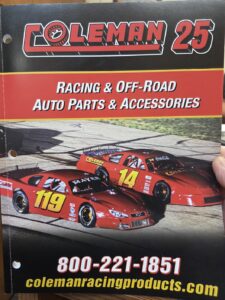
The Coleman Racing Products catalog
That catalog kept growing in size each year. During it’s peak, the popular mailer contained 250 pages of products Coleman developed and sold. “We’ve scaled back since then,” Coleman said. “ But, we lived and died by that catalog. For racers, it was sort of like getting the JC Penny Christmas catalog in the mail when it came out.”
In 2025, Coleman estimates the business sales are about half through the website, and half through the catalog. “We still take a lot of phone calls too, as some guys are looking for some technical help, along with our custom machining, And, we still get guys who dream stuff up on their own. And then often, they’ll give us a call. We can even work off a sketch on a restaurant napkin, and have.”
About twenty five percent of their business remains through local machining. Paper mills. Waupaca Foundry, and the local shipyards. “We have a lot of local industry within a 10 mile radius of our shop here in Menominee, MI, and that certainly helps,” Coleman said.
As far as the short track scene, Coleman remains a player on the pavement circles, but has also made some in roads on the dirt scene in recent years as well. “There is some crossover with the two surfaces with things like brake rotors, driveshafts and a lot of the bracketry and axle tubes, spindles and control arms. So yes, we do offer some products to the dirt track drivers, too.”
When it comes to the future of pavement late model racing, Coleman remains optimistic, and is a big proponent of the 604 GM crate motor. “I do think some of the rules packages are headed in the right direction, particularly with the evolution of the Pro late model type class at the paved tracks,” Coleman said. “They need to continue to get certain parts under control cost wise. Like shock absorbers, for example. Some of these parts are very expensive to replace when you crash. I am all for going back in time a littie bit, and go back to a conventional-style setup without all of the bump stops. Somehow, make the cars simpler, a bit easier to work on, and maybe we can draw new people into this sport.”
Whatever rules packages clubs, tracks and series come up with, Coleman’s business plan remains the same. “We’re staying the course, and the plan is to be here for the racers for many years to come,” Coleman said.