
The Vault
1999 – Q & A WITH ARTGO’S JOHN MCKARNS

Posted on: Monday February 16, 2026
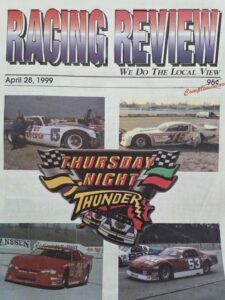
1999 – THE JOHN MCKARNS CHRONICLES by Joe Verdegan
(pulled from the April, 1999 edition of Racing Review)
For three decades, 54-year-old John McKarns has built ARTGO into one of the most successful Midwest-based touring series for short track late models. One of the tracks that ARTGO has always fared well at was Wisconsin International Raceway in Kaukauna. In 1999 McKarns has decided to step away from promoting the two traditional ARTGO dates at the D-shaped, half-mile oval, handing the projects over to GameDay Sports Marketing of Appleton. With the arrival of NASCAR and Oneida Bingo and Casino into the fold, McKarns feels like the skies the limit with what was once his ARTGO “Cars and Stars” touring series.
(The following is a Q and A conducted with John)
Q: After working with WIR promoter Roger Van Daalwyk for 20 years promoting races, what made you decide to get out of it?
A: There were a number of factors. I was aware that GameDay and Oneida wanted to do some more things. They’ve approached me with a couple of ideas. It seemed to me that it was time to step away and turn it over to them. Call it a promoter’s intuition. The fans are going to benefit because they are probably going to see a better and more interesting racing program than ARTGO was able to put on.
With the (Winston) Cup people there racing and signing autographs. The Re/Max drivers can benefit because I think it eventually will come out that there will be one of the largest paying purses ever for ARTGO or Re/Max. It’s going to be a good deal for the track and the local racers. It’s a good deal for the sponsors because they get more exposure. I’m not saying that ARTGO couldn’t have taken it but it is a big financial commitment to do stuff like that. They’re going to be in a position to sell advanced tickets and put up hospitality tents and other stuff that we just weren’t geared up to do.
The Re/Max race will be good with or without the Winston Cup people so we’re shifting gears into semi-retirement. Joe, If you’d ask me a year ago if we’d consider not running at WIR and not promoting those races it never would have crossed my mind. It’s kind of the way things developed with Oneida. It’s quite a bit of risk when you go out on a limb with these high buck shows.
Q: What are some of the memories that pop out in your mind with some of the events you’ve promoted at WIR?
A: I’ve been involved over at WIR before that. In fact, I announced quite a few races there in the 1970’s. I’m not sure if that’s in the history museum or not but I did. I was familiar with some of the bigger crowds they got there. The very first race we ran there in 1979 we attracted a big crowd and we had Bobby Allison and press conference and there were traffic backups on the highway. That was a pretty impressive deal and something I’ll always remember. I’ll always remember 1987 when we ran the first 200 lap race there and had a real big crowd. That was probably the highlight of our WIR involvement. Those two would be my fondest memories.
Q: How do the NASCAR stars of today (Mark Martin, Rusty Wallace, Dick Trickle) and former ARTGO stars rank with the Brian Hoppe’s and Jason Schuler’s of today?
A: We ran a lot of races at Capital Super Speedway (now Madison International Speedway). We ran a lot of ARTGO races there. We kept track of the “Sweet 16” that would make it into the feature. Often there was a separation of a full second between 1st and 16th on a half-mile track. Now with Re/Max there would be separation on a half-mile track of three of fourth tenths from 1st to 16th.
I think what’s happened is that the Dick Trickles and the Larry Detjens, Rusty Wallace and Mark Martin were so much further ahead of the other people it was spectacular because they were passing that 16th place car they were going that much quicker. Now if you have a Brian Hoppe or a Steve Carlson speeds are so much closer the person doesn’t standout like “wow, he came from 10th to 1st in two laps” – those elements don’t exist anymore because of the way the rules are and because you can buy an engine from B & B and a chassis from Lefthander and you’re all on the same Hoosier tires and it really equalizes things.
I think probably the guy you have to look at right now is Matt Kenseth. He was a somewhat regular in ARTGO and look at what he’s doing today in Busch and the accolades he’s getting from the media announcers and Mark Martin and people like that. It’s an impressive thing. I think the Re/Max series and the ARTGO series a few years ago are still producing a lot of really good race car drivers.
Q: The sport has changed a lot since you’ve started promoting. What have been some of the most significant changes in the sport – both positive and negative?
A: I always fall back to cost. People always talk about the good old days when they had $5,000 in their car and went racing. The cost has been one of the biggest changes we’ve seen. Years ago when you had Bob Senneker, Randy Sweet, Dick Trickle, Tom Reffner, Larry Schuler or Ed Hoffman would all race down at Grundy you really had all the top drivers in that type of racing in the same race. A lot of people didn’t know who David Pearson was.
Now, everybody knows who Jeff Burton and Jeff Gordon are. They’ve got an allegiance of Winston Cup fans who aren’t impressed when you have a less special race that has all the top ASA, ARTGO or All Pro guys. It doesn’t make the big impression like it did years ago.
I guess I see that as being one of the changes. I kind of had mixed emotions about it because in those early ARTGO races as a fan and official it was exciting thing too see all those out of town drivers come to race. I don’t think there’s that type of enthusiasm now when Joe Bellm comes from Colorado National Speedway to race at Rockford. Twenty-five years ago that would have been a big deal.
Q: Is it tougher that it was years ago to find fans who are willing to chase an entire series?
A: I’m not sure ARTGO ever really had a huge following of 50 motorhomes that followed us to every race. We did try to promote a lot of things as the annual schedule came out. When ARTGO’s in the area be sure and be there. We ran a lot of events of that nature. I guess you can only go back to the point that there are many more race fans than there were 20 years ago. When you take this Winston Cup element and consider the time and money they spend on tickets, the jackets you buy and the other souvenirs it adds up. You can go to a whole bunch of races at Madison, Rockford or WIR for the same price you pay to go to one Winston Cup event. Even though there are a lot more race fans some of the specials and weekly events aren’t growing as fast because people are spending more money on Winston Cup stuff.
Q: Should weekly tracks be afraid to schedule events head up against NASCAR?
A: My feeling on weekly racing is that it’s different than specials. You have to plan accordingly.
Our attendance at La Crosse dips a little bit when Bristol runs a night race on TV. But, our attendance steadily increases. It hurts when you lose 10 to 20 percent of your crowd when a Winston Cup race is televised. By the same token you’ve got to look at the big picture, which is that attendance and interest in weekly racing is growing, due in part to Winston Cup on TV. We wouldn’t have any plans that La Crosse not run just because there is a Winston Cup race televised that night.
I do know some of the tracks out east in preparation for the July 4th Pepsi 400 at Daytona (which was postponed due to smoke) did switch their Saturday night programs to Friday night. It’s a mixed bag. I know John McKarns opinion is consistency and we’re going to run some programs at La Crosse every Saturday night. We’ll take it from there.
Q: How much longer do you see yourself having an active hand in promoting racing?
A: We’re doing some consulting work now on a couple of interesting projects which I can’t get into. I enjoy promotion. I enjoy seeing drivers move up. I enjoy seeing big crowds at tracks. I enjoy seeing fans that are cheering and applauding and having a good time. I want to stay involved that way. La Crosse Fairgrounds track we’ve got a long term lease there. I’ll be involved in some way out there for some years to come. We are definitely cutting back on the promotions. At one time in the mid-80’s we did 30 shows at La Crosse, 15 enduros and 20 ARTGO programs. There was a lot of financial risk out there. I really don’t see that happening in the upcoming years. But I wouldn’t rule out promoting a few future events.