

The Scoop
DAVE OLSON – A HALF-CENTURY OF SNAPPING PICS OF RACE CARS

Posted on: Sunday January 18, 2026
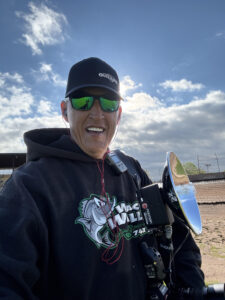
Dave Olson
From the long-defunct Hales Corners Speedway to bucket list events like the Chili Bowl in Tulsa, Dave Olson has been documenting the racing action for more than half of a century through his camera’s lens.
The 63-year-old Pewaukee native became passionate for the sport of speed on both the dragstrip at Great Lakes Dragaway in Union Grove, Wisconsin and Hales Corners as a young teen. “When I was 13, my dad took me to Great Lakes Dragaway and I grabbed his Kodak Instamatic camera and started walking around the pits and took pictures,” Olson recalled. “It was in 1976 that I got my start with the oval track stuff.”
Olson grew up a half-mile from Hales Corners. “I used to ride my bike to the track and spend my allowance at the RPM photo booth and purchase the photos,” Olson recalled. “I started taking pics from the grandstands. The colors and the sounds hooked me into the sport big time with regards to the photo side of things. Back then, there was nothing like dropping your film off and waiting 3 or 4 days to see what you have.”
Olson began asking a lot of questions, and as a 15-year-old high school freshman, was already very tall. “I began to pester the officials about when I could get into the infield and shoot pictures,” Olson said. “I obtained a pit pass when I was 15 and was super excited to shoot from the infield at Hales.”
After Olson crossed the track, a pair of track officials tracked him down, and one of those officials was good friends with Olson’s dad. “He asked me what I was doing there,” Olson said. Olson got the boot, with the word that when he turned 16, he could return.
Not to be deterred, Olson got on the telephone and began calling the promoters from several other area tracks. Tracks like Wilmot, Slinger and Beaver Dam. “I met Jerry Wikel, who was looking for a photographer at Raceway Park at Beaver Dam,” Olson explained. “I got the job as their photographer. They’ve been supportive since day one.”
It was shooting at Raceway Park where Olson developed a love for open wheel racing. “This was way before cell phones and the internet,” Olson said. “I was there with a bunch of Hall of Famers like Etchie Biertzer. Fuzzy Fassbender. Billy Johnson. That’s how it started.”
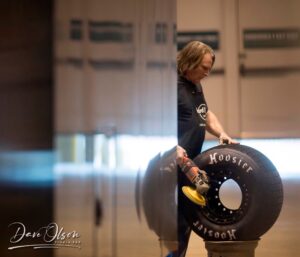
Olson snapped this pic of the late Scott Bloomquist doing some tire prep. (Dave Olson photo)
Olson began to spread his wings at the area ovals, shooting at whatever track would let him in. This was during his high school years. Olson talked his way into being the student aid in his high school’s dark room. “I shot with black and white film, and had students printing my stuff for me,” Olson recalled. “I had the school bankrolling the 5 x 7 prints that I started selling. That’s how I got started essentially on the business end of racing photography.”
Olson returned to Hales Corners on August 11, 1980 after he graduated high school. “I walked into the office at Hales Corners office and finally got my pit pass,” Olson said. In 1981, Olson really started spreading his wings, chasing races as a photographer. “I called the World of Outlaws, and asked if I could shoot pics at their tracks,” Olson said. Olson became a fully-credentialed WoO photographer. That took Olson to tracks like Santa Fe and Eldora Speedways. He would wind up hitching his wagon to USAC, and shot at legendary events such as the Hoosier 100.
It was during the ’80’s that Olson met longtime Stock Car Racing magazine editor Dick Berggren while shooting at the Knoxville Nationals. “Bruce Ellis introduced me to Dick and he said ‘You’ve got a lot of cameras kid,’ Olson said. “I asked Dick how I could land a pic on the cover page? Open Wheel magazine was also up and running. Berggren said ‘send me some stuff and we’ll figure it out.’
Olson learned how to shoot pictures vertically, and sent his files to Berggren. “One day I received a package at my parents house,” Olson said. “SCR sent me a plaque with my picture of Doug Wolfgang winning the Knoxville Nationals. It was with a letter from Dick congratulating me on my 1st magazine cover. I’ve still got that plaque in my office.”
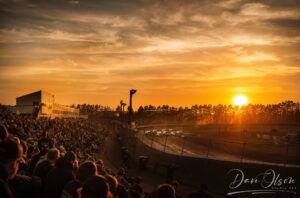
Olson captured this beautiful sunset at Mississippi Thunder Speedway. (Dave Olson)
Olson began creating what he dubbed “a lifetime of memories” in the mid-to-late ’80’s covering races from coast-to-coast, including the Daytona 500. He became friends with NASCAR stars Tony Stewart, Jeff Gordon and Ryan Newman when they were still slinging clay in open wheel sprints and midgets. “I’m still friends with those guys,” Olson pointed out. “But I also enjoy the weekly short track scene just as much. I’ve been able to shoot three generations of the same family of racers. Like the Fassbenders and the Biertzers. I shot Fuzzy Fassbender, his son Lance Fassbender and now Lance’s daughter Lily. When we get older, we look at things, there’s more to racing on the track. It’s really about the families.”
While working at Quad Graphics in Lomira, Olson learned the art of graphic design. For this photographer, his hobby was a part of putting it all together. “Before things became digital, it was a lot easier to make a living as a photographer because it was tough to create images,” Olson pointed out. “We didn’t have digital files to work with. None of that stuff. The switch to digital occurred around 2003 and film was really starting to die off.”
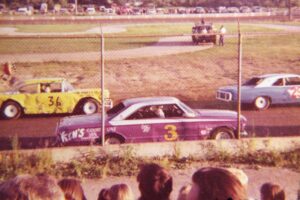
This is the first oval track pic Olson took as a teen at Hales Corners Speedway in 1976. (Dave Olson photo)
20 years ago, Olson opened up a studio, and began to shoot non-racing related things and events like commercial shoots and weddings. Olson was one of the last photographers to switch over. “With that studio, I figured I had to slice that pie pretty thin to make it work. Because these days, with all of this technology and cell phones, everything is a photographer these days.”
According to Olson, what has set him apart from other photographers is the relationships forged through motorsports. “That truly I think is one of my advantages,” Olson said. “Tony Stewart called me once not too long ago. He wanted me to design a calendar for all of his cars. It’s that relationship I had with him even during his earlier dirt track days that helps me on the business end of things. As a photographer, you’ve got to be a lot more diversified.”
While the technology has changed drastically in the past couple of decades, Olson sticks with one solid principle. And that he is simply a story teller through his lens. “To me, that’s number one,” Olson said. “That’s what the image is all about. As a photographer, it’s amazing. In my opinion, it really doesn’t matter if you’re shooting with a phone or a camera. Good equipment helps, sure. If you like what you have, that should be good enough. Don’t judge your work or anyone else’s by how many likes or followers you have.”
Not being one to throw all of his eggs in one “racing basket” per se, Olson has opened up his business Studio 360 to other photographers. He has a hair and makeup team available for things like wedding shoots, for example. “I love the family element of what I do, and I also love teaching younger photographers,” Olson said. “I want to help and encourage them. I want to see them develop their own style. It’s not all race cars anymore. This technology changes just like computers. Sony comes out with new cameras twice a year. Here I am shooting with five-year-old Sony cameras. It doesn’t make financial sense for me to update every year. AI is a huge deal now, too. It’s going faster than what we can keep up with.”
Outside of photography, Olson has other hobbies. He loves to golf, and also relishes musky fishing. “I had a stroke four years ago, and now I really look at things differently,” Olson admitted. “I’m lucky to be here. That was a tough time. I look at things in 24 hours now, even though that may sound cliche’.”
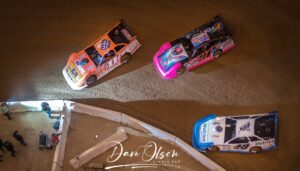
While Olson has a love for open wheel racing, he also enjoys shooting other classes, like dirt late models. (Dave Olson photo)
Olson remains steadfast on being positive when it comes to the bear of social media, and it’s effect on short track racing. Things like Facebook and X (formerly Twitter) can be both a curse and a blessing at the same time. “Negativity breeds negativity, but so does positivity,” Olson said. “I’d encourage everyone to spread the GOOD stuff of our sport. I feel it’s a responsibility we ALL have. As for me, there are still some tracks I haven’t been to I’ve got on my bucket list. I haven’t been to Pennsylvania yet. Never been to Eagle River Speedway, but I musky fish up that way a bit. And I haven’t been to Shawano Speedway in more than 30 years. I’m looking forward to returning there in 2026. I’ll keep doing this as long as I can.”
You can check out Olson’s work at his website studio360photo.net.